
A volume pedal can be something that you don’t pay much attention to. After all, why bother getting a pedal when you’ve got handy knobs on your guitar to adjust the master volume, right?
If you have been playing guitar for a while, you may know that there is a ton of value that pedals- as tone-enhancing accessories can provide while playing on-stage or recording in a studio.
I know that I’ve been guilty of saying that the only pedal that you will ever need as a guitarist is the reverb pedal. That’s absolutely true if you are on a budget and don’t have a lot to spend.
The most important why I would suggest that you look into volume pedals when gear-shopping is that having a volume pedal can help you make your life easier if you regularly find more ways to include innovative techniques like tone-bleeds and dynamics into your playing.
In this article, we will talk a lot about volume pedals, and if you are new to pedals in general- I will also be going through that. So, stick around to the end to find out which pedals are worth looking into, and what guitar volume pedals can do for your tone.
Table of Contents
What is a Guitar Effects Pedal?
For the newbie guitarist, guitar pedals can be confusing. Almost every seasoned pro uses a pedal when playing live, and you may be intimidated by the number of pedals and terminologies there exist.
And to further add to the confusion, there are plenty of new names being invented by major brands.
In simple words, a guitar pedal is just something that lets you get a different sound. Whether you want a mushy tone, a vivid dreamy tone, or a dirty aggressive tone, there’s a pedal for everything.
You usually activate the pedal with your feet and change the settings while you are playing. The fact that you can use your feet while your hands are engaged in something will prove to be very important for you. Because, if you had to use your hands for using pedals, you would be very limited- think of a performance where you are shredding on your guitar, and constantly switching pedal effects in-between. Pretty hard to do, right?
There are many pedals out there- but the ones I would suggest you look into are the ones that every beginner should absolutely own- a reverb, looper, and a delay pedal. There are ones like overdrive, volume, phaser, flanger, wah, tremolo, and chorus, but as a first pedal, looper would be absolutely wonderful.
That said, you can go for a volume pedal just as well, as dynamics are an important part of playing expressive music.
The Volume Effect Pedal
Many guitarists don’t have much exposure to volume pedals and just assume that all a volume pedal is capable of doing- is changing the volume, which is somewhat true. But there’s a lot more to that.
You will find that there are two types of volume pedals that guitarists use- the active volume pedal and the humble passive volume pedal.
The terms active and passive just say whether or not the pedal actually requires power. An active volume pedal will require power while a passive pedal won’t. You will get passive volume pedals at a much cheaper price than the active models, which is actually quite nice.
Volume pedals also have something called an impedance rating. In electrical circuits, impedance just means the opposing property of the circuit to the flow of current. It’s probably easier to understand when I say that the higher the value, the higher would be the impedance.
If you have a 60k impedance pedal and a 300k impedance pedal, the former would be the one with a lower impedance rating and the latter would be the one with a higher impedance rating.
There is something that you need to know about passive pedals- and that’s got to do with something called tone suck. There are just some leaks at the top end if you are getting a passive pedal which is barely noticeable- but it’s there.
You can also get more tone suck on a passive pedal with a humbucker pickup compared to a single-coil, which can be even more prominent in a high impedance setting. If you don’t want to deal with it, you can go for an active volume pedal, which is what I would suggest.
If you would like a more or less stable signal from the guitar, getting active pedals is a great idea. You are also getting a buffer which does a great job at maintaining the signal level. This feature is the main reason why active pedals are more expensive compared to passive pedals.
The most common way to use a volume effects pedal is to use it at the start of the signal chain. You are actually getting more gain if you keep dialing the volume up, which can be good for passive pedals.
Placing the volume pedal at the right place can make a lot of difference in tone. You want to place the volume pedal just after an overdrive pedal if you would like to use volume swells in your playing. After that, you can place effects that have to do with time- like the reverb or delay.
One thing that you may not consider right away is the size of the pedal that you are trying to use- and trust me, it matters a lot. If you have got small feet, it’s not much of an issue but if you have large feet, having a pedal that’s comfortable should be your priority.
Best Guitar Volume Pedals

What We Like
I know that passive pedals get a bad rap among guitarists, but trust me- the Boss FV 500H offers an incredible value for the price despite the low asking price.
I love that the Boss FV 500H is available in two flavors- a low impedance model and a high impedance model. Personally, I would go for the latter model as it’s got a characteristic sound that sounds pretty amazing.
Talking about the construction, you get a die-cast Aluminium body which is built to be pretty sturdy. I don’t like pedals that feel cheap- so the Boss FV 500H feels quite nice as it has a nice weight to it.
When talking about pedals that you are controlling with your feet, it’s also a good idea to check if the top surface is non-slip, is the case on the Boss FV 500H pedal.
I also love that this pedal has got a minimum volume control knob which feels pretty decent. If you were used to the interface on the previous FV 50H model, you will feel the newer model is fresher and more intuitive to play around with. There is also an adjustable pedal action on this which can be very helpful if you are used to a different action on a different brand effects pedal.
There are many guitarists who like using a tuning pedal in conjunction with their other pedals. If that’s you, you can hook the volume effect pedal to a tuning pedal very easily with the jack on the side. You could also use this pedal as an expression pedal if you would like to.
If you are not one for heavier pedals, I feel like the weight of this can be a turn-off for you, but I find that it’s not that heavy. It weighs just 1.6kg which I think won’t be that troublesome if you are going to be carrying it around for gigs and rehearsing.
I think the FV-500H still shines in the budget range as a fantastic guitar effects pedal as a passive pedal. It’s a great choice for beginners as it’s cheaper than a decent active pedal by a lot.

What We Like
Now that we’ve talked a bit about the passive guitar effects pedal, let’s move on to some active guitar volume pedals.
The Ernie Ball MVP is a fantastic pedal for the price- I say this not because it’s cheap but because it offers incredible value for what you are paying.
It’s in a similar price range to the FV 500 H, which makes it a good choice for anybody on a limited budget as well.
You are also getting a surface that’s non-slip which just means that your feet won’t slip off the top surface. I think passive pedals are usually good at incorporating the minimum volume control which is very intuitive.
Talking about the quality of the build, you are getting aircraft-grade Aluminium housing that will last you many years to come.
One of the things that I really like about the Ernie Ball MVP pedal is that it’s a bit bigger than most pedals out there. While that can be a bad thing if you are trying to fit it on a small pedalboard, it’s actually quite nice for somebody with large feet. I, for one, certainly don’t mind the larger size.
One of the things that I really love about the Ernie ball Mvp is that you don’t need to worry about the signal chain either. Since it’s an active pedal, you can put it anywhere in the loop and the buffer inside of the volume pedal will take care of the fluctuations for you.
If there is one thing that I don’t like, it’s the fact that the pedal can sometimes produce single bleed which can be undesirable. It’s not that problematic but pressing on the pedal can help get rid of that.
If you are getting an active pedal, you need to be worrying about the batteries too. The Ernie Ball MVP is powered by a 9V battery, but you can also go for an adapter which you would need to buy separately. Personally, I prefer using the active pedal with batteries as it means that I can easily practice without worrying whether electricity will be available or not.
What We Like
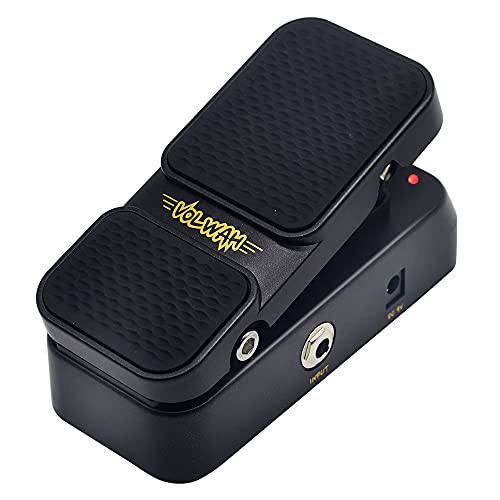
If you are in the mood for a cool-looking pedal that can also double as a wah pedal, you would be very happy with the Sonicake VolWah pedal.
Just like the previous pedal we reviewed, it’s also an active pedal so you need batteries or a power source to play along with it.
The construction material for this is plastic which makes it rather light. There are no issues about durability or finish which is good to know.
One that I would be concerned about is that the Sonicake VolWah pedal doesn’t have any output for the tuner and lacks minimum volume control. This may sound bad but if you don’t use a tuner pedal, it won’t matter for you at all.
If you are somebody who doesn’t have large feet, and just needs a decent pedal that is affordable and sounds nice, this pedal offers excellent value to your playing. You also don’t have to worry about this pedal hogging up a lot of space in your pedalboard which is quite nice.
What I like the most about this pedal is that you actually get a Wah pedal included, which is super handy as you can easily emulate the sounds of your guitar heroes like Hendrix or Satriani with a single pedal. Of course, you still need some delay and fuzz, but this pedal will at least help you get started with a pedal.
If you are curious how the wah on this sounds, it sounds exactly like the Jim Dunlop Cry Baby which is an excellent sound.
You will be happy to know that this pedal is battery-powered as well, which is nice as it allows you to plug it in without actually hooking up to a power supply. But it can also be frustrating sometimes if you run out of batteries mid-performance. One thing that I would also like to mention is the fact that this pedal doesn’t actually include a power adapter.
It does support one but you need to get it separately which can add to your buying costs. I recommend that you also get the power adapter if you are getting this pedal as it can come in very handy sometimes.
If there’s one thing that I don’t like about this pedal, it’s actually the fact that it can sound a bit harsh sometimes. It can also do wonders to your playing style, but if you are trying to play clean, you may not be able to adjust the full range of dynamic control.
If you are a beginner, you may have mixed feelings about adjustable pedals. I like them, but there are many guitarists who don’t. I’m saying this because the Sonicake VolWah pedal is a non-adjustable one and you need to be careful about your footing when using it with your gear.
There is also a LED indicator on this which lets you know what mode is currently being selected- the green one is for volume and the red one is for Wah. I think that’s super intuitive. It’s not just the indicators and the wah that I’m excited about- you also get all the bells and whistles that you normally would with an active pedal.
That includes stuff like auto-adjustment of the pickups levels with the impedance levels and not having to worry about any hidden noises in the mix.

What We Like
If you are looking for a guitar pedal that’s a bit different from the rest of the breed, the Morley 20/20 guitar volume pedal is a wonderful choice for you.
You also get the Electro-Optical technology on this is pretty fantastic as it won’t be producing any unwanted sounds while you play through it.
What I like the most about this guitar pedal has got to be the adjustable audio taper which will help you be very precise with how you want the sound to be. I love that you can easily switch between rhythm and lead, so the pedal is super versatile.
Most pedals on this list will only work with guitar, but this effect pedal works perfectly with essential bass guitar pedals as well as keyboard. If you like playing multiple instruments, you will find this pedal versatile and super helpful.
Buying Guide to Your Next Pedal
I think having the options to choose from many pedals is a great thing. Unlike in the past, even the cheapest effects pedals are of an amazing quality.
The more important thing to note is that you don’t need to get an expensive pedal right off the bat. Knowing when to choose a good value pedal from an overpriced guitar pedal is one fo the essential skills that will help you tremendously in your guitar journey.
Also, you may not really need a volume pedal if you are a beginner but if you already quite advanced and know some songs, it might be a good idea to invest on a good volume pedal.
It can be especially helpful if you don’t want the hassle of having to change the dynamics with the knobs on the guitar itself.
The first thing that you need to consider when getting a volume pedal is that the pedal should actually be within your budget. It makes no sense to spend thousands on a pedal as a beginner when you could actually invest that money into your playing.
The other thing that you may want to keep in mind is that you need to get an active pedal if you don’t want to hear the noise that tags along with an increased gain. On the other hand, if you want a pedal on a budget, you should be looking out for a passive pedal. That would also allow you to use without any power source, thus eliminating the need for an AC source or batteries. Beyond pedals, many guitarists also find value in investing in a portable mini amp for convenient practice and travel.
Final Thoughts
It’s actually super easy to get started with a volume effect pedal. Just pick a pedal- active or passive, and get started learning the ropes. It may sound intimidating at first, but I would suggest getting started with an active pedal as it automatically buffers the sound so you are avoiding annoying noise which is good.
For beginners on a tight budget, a passive pedal can be the better alternative as it’s comparatively cheaper, but if you can add a bit to that, you would be investing on your own progress with an active pedal. If you decide to go with passive pedals, you also need to consider the position of your effects pedal in the signal chain.
If purchasing batteries is something that you don’t want on your errand list, you might be better off with a passive pedal. In the end, it all boils down to personal preference. Considering the size of pedal may is also something that you absolutely need to do if you are concerned about comfortable use.
Whichever pedal you decide to get, I hope that this article has helped you in some way.
Frequently Asked Questions
Are volume pedals expensive?
Not at all, most volume pedals come rather cheap, but if you are looking for a pedal that’s super cheap, you can try looking at a passive effect pedal.
Should I go for a lightweight pedal or a heavy pedal?
If your routine involves gigging around and traveling, I would recommend getting a lighter pedal but if you aren’t worried about carrying it around, you can go for a heavier one. I find that weight is the least one of my concerns if the pedal I am getting is suitable for my needs.