
Power chords are something every beginner should know before they can officially call themselves a rock guitarist.
If you’ve ever heard a rock song, you already know that these have plenty of power and intensity into the mix. Power chords are exactly that!
Power chords are used all the time by guitarists- and they’re just bunch of notes stacked on top of the lowest notes as opposed to playing chords which involves fretting more notes. It’s very common to find thirds omitted from the power chords. The reason I love using power chords is because they sound neither like super happy major chords nor like the gloomy minor chords- they just fit in nicely with whatever you are playing, which is great.
You may think that a power chord is boring as it’s got only two notes but you will be surprised by how powerful it sounds. On top of that, you can always add any notes you want on top of the power chord to make your own variation- and you also have the option to double up on certain notes as you see fit.
Power chords aren’t exactly hard to play- in fact, they are some of the easiest things you can do on your electric- but that doesn’t mean that these chords don’t sound awesome!
I’ve also included the chord diagrams so you can follow along easily- but before we get into that part, let’s talk a bit about power chords, shall we?
Table of Contents
What are Power Chords?
Simply put, power chords are just a bunch of notes played- the root and fifth to be precise. If you were playing in a scale of C, the C power chord would be C and G notes played together- and if you were in the key of A, the A5 chord- or the A power chord would be A and E played together.
You can do a lot of things with just the two notes- but players like to experiment with adding seventh and ninths to make their arrangement sound more pleasing.

Whether you want to learn blues and soul genre or just want to have something to learn, learning to play power chords and mastering them will certainly help build your confidence.
You should also know that power chords come in two flavors- and these are the standard ways to play power chords.
You can of course, try playing power chords by using two handed tapping or harmonics but we’re not talking about those crazy techniques here.
Open-position:
The very first chords most beginners learn on the guitar are probably the open chords. Similarly, you should also learn power chords in open positions first- it’s not much of an issue related to the difficulty but it’s just good to know- as you’re only going to be fretting a single string and playing the other string in open position for power chords in open positions.
These chords include the E, A and D power chords if you have your guitar tuned in standard. If you are familiar with alternate tunings, you can experiment with the shapes as much as you would like to.
Once you know these open-position chords, you should practice playing them when you encounter a song with major/minor A, D and E chords.
Movable:
The other type of power chord that you should be aware of are the movable barre chords. Movable just means that you can slide the shape up or down to get a different power chord. These chords are based on the E or A barre shape.
The reason why I think you should learn the movable shapes is so you can transpose chord changes to any key you want. Knowing the fretboard and some theory also helps with that.
Power chords have been used by many iconic guitarists throughout decades. In fact, the music we listen to today wouldn’t have been the same without power chords being a major influence on the electric guitarists.
I’m sure you remember the chorus of Johnny B. Goode and many Green Day songs. Many rock bands like Coldplay and Maroon 5 use power chords in their playing quite a fair bit.
I’ve heard of many guitarists who were drawn to the sound of an electric guitar after hearing power chords being played with distortion and overdrive. Personally, I prefer a bit of fuzz in the mix as well, but if you don’t know what any of it means, you should just know that power chords are used in rock, blues and metal to create heavy-sounding riffs.
String chugging and tight chorus sections have all benefitted from the versatility of power chords. The reason why many guitarists don’t like playing fuller chords with complex harmonies is because when you’ve got your guitar connected to the mixer, it will all mix together and sound like crap. Usually, rhythm guitarists will want to keep out of the frequency range of bassists and lead players.
By playing power chords, players can not only ensure that they aren’t overstepping on other players’ territory but also make sure that their playing doesn’t sound muddy.
Why You Should Learn Power Chords
As a guitarist, you should try to pick up as many different techniques as you can- and if you feel motivated enough, diving into different genres can also be a great idea. As you improve on your guitar journey and keep learning new things, you will realize that not all skill is of equal value as a player.
There are a handful of reasons why you should learn and master power chords, and no real reason not to tackle them.
Easy
Power chords are super easy. Even if you are a beginner, you will get used to them in no time at all.
Anything that’s easy is always recommended for beginners as it not only helps them learn new things but it also helps build confidence to tackle much harder things later on.
That said, getting power chords to sound good can take some time because you need to be muting the strings as you are playing.
Versatile and Can Be Used Anywhere
Unlike major/ minor chords, power chords are neither major nor minor. The third interval makes a chord major or minor- and the absence of a third in a power chord can be a great thing.
As we talked about earlier, a power chord is just the root and the third – so it doesn’t include the third, which also means that you can use power chords in place of both major and minor chords. If you want to get on with it- and not think about the chord choices you’ve got, power chords can be a time-saver.
Also, if you are somebody who knows limited chord shapes, power chords can be a good substitute for any chord shapes that you find hard to play on the fretboard.
Intense sound- great for punch
If you want a chord shape that sounds intense and powerful, power chords will be just perfect for you. There’s a reason why rock and metal players are so fond of power chords- the punch that power chords offer! These chords actually offer the power you need in your playing.
I also recommend adding distortion and overdrive for a powerful tone, and exploring the best guitar effects pedals can further enhance your sound.
Ear Training
Even if you’re a beginner who is just learning the ropes of an electric guitar, learning to play a song by ear can be a great exercise- and it’s something every guitar sensei recommends.
The thing is- most songs have complicated parts- and the harmonies can be hard for you to figure out. So, an easy way to learn a song is to play with power chords. Over time, as you get better at picking up parts and figuring out whether a chord is major or minor- you can move on from power chords, but till then, power chords will save you in a variety of situations. Another effective method for learning popular songs and understanding their structure involves reading bass tabs.
Learning to Improvise is Easier
When you are first starting to improvise on the guitar, you can be tempted to learn and play around with fancy shapes but hear me out- if you try expanding your vocabulary starting from the power chords- by adding to the root and fifth, you will have an easier time getting familiar with how each scale degree sounds.
Basic Power Chords
Before we get into all sorts of complex stuff about chords and harmony, I would like to introduce you to basic bass guitar chords– you know, the ones you should know in order to nail down any rock song really.
C5
C5 is the most common power chord you will encounter. You are supposed to fret the fifth string on the third fret- and fourth string on the fifth fret together- while muting any strings that aren’t being played. The nice thing about the C5 power chord is that you can also use this same shape- and slide it across the fretboard to play other power chords across the neck.
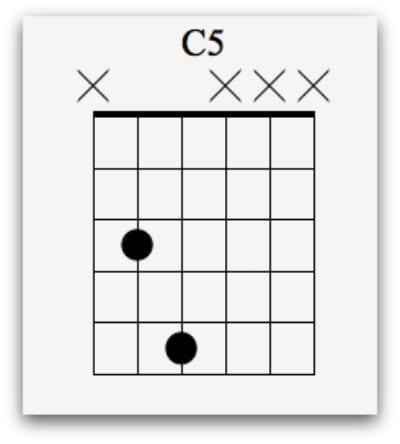
Slide the C5 shape a fret down, and you’ve got the C#5 power chord- one more fret down- and you get the D5 power chord, and the pattern goes on and on.
A5
Like most chords on the guitar fretboard, A5 can also be played in a variety of ways. The easiest way to play A5 is by playing the fourth string second fret and the fifth string open.
The other way is to play the sixth string on the fifth fret and fifth string on the seventh fret. You can try both to see which one you like more- it’s a good idea to know both so you can use both of them when convenient.

Memorizing chord shapes also helps you play without thinking and is crucial for improvising. Mastering barre chords can significantly expand your ability to play across the fretboard and explore new musical keys.
E5
The easiest way you can play the E5 chord is by sliding the C5 shape down to the seventh fret. You can also play the sixth string open and fifth string on the second fret.

Power Chords With Three Fingers
You can also play power chords with three fingers- no you’re not playing three notes- you’re just playing two notes but the root is being doubled.
To play a power chord with three fingers, you would simply play a normal chord and add a finger on the string below the fifth note on the same fret.

For example, if you want to play a C5 with three fingers- you would first need to make the regular C power chord with the index on the third fret fifth string, and ring finger on the fifth fret fourth string. Then, just add the pinkie finger on the fifth fret of the third string. This way, you are just doubling on the root note for a fuller sounding chord.
Songs That Can Be Played With Power Chords
There are thousands of songs that can be played with power chords and if you’re a beginner just looking to get started with your first couple of songs, this list can be a great place to start. For silent or on-the-go practice of these tunes, consider using one of the best mini amps available.
Green Day – 21 Guns
21 Guns is easy- but more importantly, it’s a memorable song that you’ve probably heard many times. The classic song has got super easy power chords that require little to no effort- and if you keep practicing, you can very easily master that in no time at all.
Seven Nation Army – The White Stripes
Seven Nation Army is a fantastic song to learn for a beginner- and the fact that it’s got power chords is an icing on the cake.
Smoke on the Water – Deep Purple
Smoke on the Water receives much hate from guitarists and non-guitarists alike, but if you can get ahead of that, you will find the song an exciting one. It’s got catchy riffs- and can be played entirely with power chords which is great.
Spicing Up Power Chords and Improvising with Basic Chord Theory
Before get into the musical vocabulary, it’s a good idea to revise the basics. After you know about power chords, the theory involved and notes on the fret-board,you can confidently improvise melodies and jam along with your friends.
Minor Pentatonic:
You can experiment with minor pentatonic scale which is just 1 b3 4 5 b7. In a scale of C, that would be C Eb F G Bb.
If you are playing a C5 chord, you can simply add the Eb, F and Bb notes. It can be fun to do this on a jam.
Major Pentatonic:
The major pentatonic offers a wonderful sound- and the notes involved are 1 2 3 5 6, which would be C, D, E, G and A.
I wouldn’t try a major pentatonic in a rock context, but you can certainly experiment with it to see if you like how the scale sounds. For those exploring different instruments, understanding bass scales for beginners is a valuable step in expanding your musical foundation.
How To Play Power Chords Clean
Since it’s easy, and even beginners can play power chords, it must be super easy to master, right? That’s where many guitarists trip themselves up.
It has taken me many weeks of practice to make sure that I am not playing any strings that I’m supposed to be muting. Techniques like palm muting can be good at that.
I think the best way to drill the power chord shape properly- is by taking it slow. Eventually, you will be able to build the speed you want, but for now- concentrate on playing something slow and nice till you can’t make any mistakes.
Playing with the index finger first
When first starting out on the guitar, the finger we most commonly use to fret strings is the index finger. Just try pressing the index finger on the root note – and build your power chord based on that.
Later on, once you get comfortable with using just your index and ring fingers, you can start incorporating the use of middle and pinkie fingers. It will gradually begin to be easier that way. Regardless of what players say, using the pinkie can certainly improve your picking speed if you are using all four fingers while playing on the fretboard.
Proper picking
It’s easy to overlook the role of your picking hand and proper plectrum technique because you are constantly looking at your fretting hand and not paying much attention to what your picking hand is doing. But if you want your power chords to sound crisp and powerful, you should only strum the strings that you are pressing on- and mute the ones that are not being pressed.
Doing this also helps improve tremolo picking. You can also try alternate picking power chords to get a feel for it.
Proper thumb position
It’s important that you are paying attention to where your thumb is resting. Normally, it should be resting under the fret-board and if you bring it on top of the frets, it can also provide some support to the fretting fingers.
Make sure that you are fretting the respective frets and each note is ringing loud and clear. This is the key to mastering any chord shape.
Down strums and Alternate strumming
Before you try strumming fancy patterns, it’s a good idea to keep it simple. Make sure you can down strum in time before you move on to up-strums and patterns.

A simple 4/4 beat can be very useful for this. Just play four down-strums paced uniformly. I also recommend getting a metronome for this. It helps a lot when you are trying to develop musicality and improve your sense of rhythm.
Most players don’t use full strumming patterns when playing on an electric guitar because it can seem too muddy- just a couple strums will suffice but make sure you nail down the changes.
After you’ve mastered the down strums, you can then move on to slightly challenging patterns like dd-uud-dudu and the variations as you get more comfortable.
Tips To Improve Faster
I think the best way to improve faster on guitar or any other instrument, really- is to make sure that you have a clear path ahead. Having a teacher to guide you and monitor your progress can be a blessing. Even if you are self-taught and don’t have the budget to hire a tutor to track your progress, these tips should help you make the most of your practice sessions. These same principles apply to other musicians too, for example, becoming a better bass player requires similar dedication and strategic practice.
Listen To Your Playing
The easiest way to improve on an instrument- and something that every professional does to know their weak points- is listening to their playing.
The sound you hear while you play and the sound others hear can be very different. So, you should record your playing often and try figuring out ways to improve on that.
One thing many beginners do wrong is- they bash on their playing thinking it will never amount to something. You should never be too hard on yourself- if you keep at it, you will eventually gain skills and accomplish the goals you’ve set. Just keep trying, and focus on improving, one thing at a time- and you will get there in no time at all.
Clear Goals
If there’s one thing that can prevent you from reaching your potential, it’s the lack of well-defined goals. There’s an acronym in business studies that tells how your goals should be set. It should be SMART which stands for specific, Measurable, Attainable, Realistic and Time-bound.
Setting goals this way is very essential to make sure that you are actually making progress, even if it doesn’t feel like much. The key thing is to make sure you are always learning something new and headed in the right direction.
If I am learning to play power chords, I would focus on playing a single chord right and make sure that it’s the best I can do, or I will keep trying to make sure that it is loud and clear, and I am not muting any strings I should be playing or vice-versa. Understanding these learning principles can help manage expectations about how long to learn bass or any other instrument.
Metronome is your friend
If there’s one thing that will help you improve fast, it’s got to be the metronome. If you’ve never heard of it- it’s just a device that makes a ticking sound.
A simple device that produces continuous beats isn’t very effective at improving your musicality on its own- but if you begin listening to it and playing along to it, you will be able to improve your sense of rhythm and increase your speed as well.

An easy way to use a metronome is to play a down strum on each metronome beat. You can also try changing chord shapes with the metronome beats. This can be tricky at first- so practice playing changes at a smaller tempo first (something like 60 beats per minute) before you move on to speeds like 120 or 200.
What separates a good band from a typical band is that good bands usually have members who can tell if the instruments are lagging behind the drum beat or rushing. You don’t want to be rushing or lagging unless you know that’s what you want to be doing with your instrument.
Playing along to a 4/4 beat can be very helpful when first starting out.
C5 A5 G5
1 – 2 – 3 – 4 | 1 – 2 – 3 – 4 | 1 – 2 – 3 -4
DB-30C Dr Beat Metronome by Boss is a cool gadget if you would like to have an inexpensive metronome that’s still good quality.
Learn Actual Songs
Learning chord shapes and internalizing rhythms can be a wonderful thing but if you aren’t playing along to real songs, it beats the purpose of learning to play guitar. There are countless songs by Green Day and Metallica that use power chords- I would recommend starting out with NIB by Black Sabbath.
It’s a great place to start- and you will love that it doesn’t sound boring. It’s actually one of the very first songs I learnt to play on the guitar, and I love playing it to this day.
Final Thoughts
Summing up, power chords aren’t even that difficult, and learning them can add a whole new dimension to your playing. Not only do you need to know them, but you also need to experiment with improvising to add them to your playing and add the shapes to your repertoire. To further develop your musical vocabulary and visualize these concepts, understanding guitar fretboard charts and chord diagrams can be an invaluable resource.
Knowing power chords can be a valuable tool in your arsenal as a guitarist. Whether you’re planning on mastering rock songs or improving chops to play metal at light-speed, I hope this post has helped you in some way.
Frequently Asked Questions
Which is the easiest power chord to learn?
Most power chords are super easy, but I find that the E power chord is even easier because you just have to fret a single note and play the other one open. You should try playing all power chords, and if you find some harder, just keep practicing and you will get used to it in no time at all.
Should I learn power chords or just regular chords?
Learn both! Power chords can be used as a substitute to regular chords but you should also be able to play regular chords. These sound different, and that’s the main reason you should learn them.
How can I add to power chords?
You can double notes of power chords, add seventh and ninth notes- and try experimenting with little tricks to incorporate in your playing. This can be tricky at first- but over time, it will become second nature and you will be used to doing such things regularly.