
Anybody who has ever picked up a guitar knows that a seasoned guitarist can twist and turn their fingers in strange fashions, and the ‘chords’ a pro guitarist plays are mostly not the open chords they were taught.
It takes a lot of time and practice to drill the muscle memory required to effortlessly switch between chords. And if you are talking about mastering barre chords, you are going to need a significant amount of dexterity and strength in your fretting hand.
Learning any new skill on guitar, or any instrument really- can add a whole new dimension to your playing. Not only do you acquire a new skill, you will also find multiple ways to
In this short review, we take a look at the barre chords on the guitar, and the most efficient way to master it. Let’s get started!
Table of Contents
What Are Barre Chords?
The first chords you learn on guitar are usually super easy ones like the Open D or the E major chord. As you get better at playing guitar, you will find that you can move the same shape across the fretboard and get different chords. Visualizing barre shapes can also be super helpful when trying to learn the CAGED system for soloing over chords.
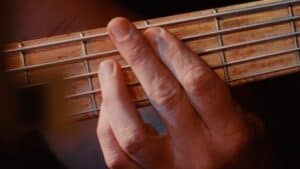
You fret bar chords by ‘barring’ a fret with your index and forming an open chord shape with the rest of your fingers. It may sound intimidating but it’s very easy once you get the hang of it.
Since the notes in a barre chord (if you form the bar shape on the upper frets) are being played on a higher register, learning bar chords also lets you improvise along with the rhythm player in your band on a different octave.
Are Barre Chords Hard?
There is this really common misconception that bar chords are harder than regular chords, and part of the reason for that may be the fact that a beginner is already used to some open chord shapes before. When you actually get to learning barre chords, your fingers are used to common shapes but the fingers aren’t just strong enough to barre a fret fully.
I don’t think learning barre chords is hard at all, and I think that’s because I’m used to the process of learning. I would say that learning arpeggios all over the neck are actually harder than learning to do proper barre chords because that requires way too many hours of dedicated practice.
With bar chords, you just try pressing a barre on some fret that you are comfortable with, and within a week or two, you will be able to make some visible progress.
How To Play Bar Chords?
So, now that we’ve covered some ground, let’s actually get on to learning to play barre chords.
For a beginner, the first barre chord I would suggest is the A barre chord or G barre chord which can be played by putting your index on the second fret and pressing down on all strings above the fifth (A string).
There is also such a thing as proper technique, and playing with proper technique allows you to prevent some of the muscle soreness and carpal tunnel that is common with many guitarists who adhere to rigorous practice sessions without warm-ups.
Regardless of your reasons for learning barre chords, you will find that learning them will open a whole new world of chords and visualization patterns that will help you become an all-rounded player.
If you ever come across a Bb chord, you can play it super easily with a barre chord. If you hear fancy names like Dm7 or F#min, you don’t have to fret- as you can easily fret them with barre chord shapes (pun intended).
There are just two things that you need to keep in mind to master the dreaded bar chords- technique and dexterity. A crisp sound is just an outcome of efficient practice over a period of time. Beyond open chords and barre shapes, exploring power chords for beginners can further expand your harmonic vocabulary.
I think open chords sound amazing but that doesn’t mean that you need to stick to just these chords. If you want to get to make your own chords by understanding barre chords, knowing barre shapes would be a great starting point.
Playing with a capo also lets you play up in high registers but some guitarists do think of it as cheating. Personally, I really love the brightness that comes with a capo, and honestly, anything that will help you practice the instrument more is a great idea.
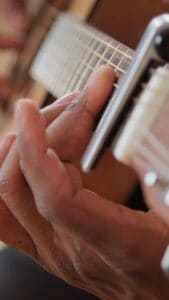
Many people just start off with an F-barre chord as they think it’s the logical chord to learn after the C-chord. It also fits right in with the chords in the C major scale family, so you may be tempted to start with F-barre.
From personal experience, I know that bar chords are harder to play near the nut as it’s a bit more difficult to press strings near the nut than near the mid-parts of the neck.
Instead of starting out as most players do, I suggest you practice chords with the root at the fifth or seventh fret. As the strings are easier to press there, you will find that the barre chords are also easier to fret.
Doing an Eminor barre chord is super easy, and is a great starting point for any beginner who is reluctant to learn barre chords.
Next, the B major barre chord is also pretty convenient to play. You can practice shifting between E minor and B major chords.
Are you finding it hard to play barre chords?
There can be many reasons why you may be finding it hard to sound barre chords. One of the reasons why it can be so can be because you may be muting some of the notes you are trying to press on.
If barre chords seem super hard to you, I’m including a few tips so you can improve your skills faster. Using a portable mini amp can greatly enhance your practice routine, making it easier to refine your technique anywhere.
Check the action
Action on a guitar neck just means how the strings are from the neck of the guitar.
It’s actually a more common issue on older guitars and in places with high humidity changes.
You don’t want a super low action either- if the strings touch the frets while vibrating, there will be an annoying buzz. So, you should be going for a decent height on the strings that won’t buzz or be hard to fret.
You can visit a guitar shop and ask the tech guy to fix intonation and stuff. It also helps if you know how to do some minor repairs. It takes just a cheap truss rod that lets you adjust the string action and a bit of fiddling. For optimal playability and sound, learning how to string an electric guitar properly is an essential maintenance skill that complements these adjustments.
This is one of the most common issues that guitarists have when learning.
Is your technique good?
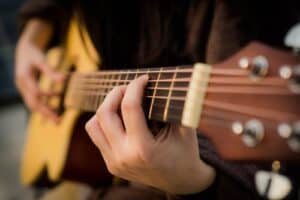
There are many pro guitarists who play with weird hand positions. There isn’t really a right way to play instruments but you will find that sticking to good habits can be super helpful in the long run for effective practice.
You can avoid muscle injury as well as learn the same stuff faster. A standard practice that every guitarist follows is placing the thumb roughly halfway down the neck (on the backside). You will also find that it can be very hard to play barre chords if your hand isn’t placed properly.
Fretting near the frets!
When pressing on strings, it’s always a good idea to fret just above the frets. This helps press the strings easier and also helps with the intonation.
If you are unsure about your technique, a quick visit to a guitar instructor will solve almost all of your problems.
Conclusion
It can be intimidating to start learning barre chords but trust me, it gets super easy with practice. I hope that you have found this article informative.
Frequently Asked Questions
Which barre chord is the easiest to learn?
I think any barre chords that are played by fretting five strings towards the mid-part of the neck are pretty easy to play. You can start with the A major chord or B major but any chord is easy if you keep practicing!
Is there a trick to bar chords?
To be honest, there is no trick to playing barre chords effortlessly. You just need a properly set-up instrument and stick to your practice habits and you will master them in no time. For those wondering about the broader journey, understanding how long it takes to learn bass guitar can provide perspective on mastering any instrument.