
If you’re a beginner and have always wondered if you can play the bass through a guitar amp, this post is for you. Instead of just a single-word answer, I’m going to break all the theories behind the bass tone and what actually happens when you try to play bass through a guitar amp.
The short answer is yes, but… There are always going to be many buts any time you try to do things the unorthodox way. Does it sound as good? Probably not, and that’s a solid reason to get a bass amp.
In this post, I want to get into all of the interesting details about amps- guitar amps and bass amps in particular, so you have a good idea of what we’re talking about. Before we get into how the guitar amp would handle a bass plugged in versus a bass amp, let’s talk a bit about amps and the technology used so we’re on the same foot here. Let’s get started!
Table of Contents
Workings Of An Amplifier
Any guitarist or bassist knows how important amps are. Without amps, you cannot have the sound that makes the tone of most rock and blues bands.
An amplifier is a fairly simple device with some electronics lodged inside the box compartment. I think knowing your amp inside out is good for many reasons- one, you will have an easier time figuring out the tone you want, and the other- if in case your amp breaks for some reason, you will have some idea as to what happened. You can be well on your way to fixing the damaged components if you have the right tools.
As you may already know, electric guitars and basses don’t produce sound with a hollow resonating chamber as acoustic instruments do. They’ve got pickups that pick up the sound vibrations from the strings and convert them to electrical signals which you can pass to speakers but won’t be very audible. In order to make it audible, the signals need to be amplified first- and that’s where amplifiers come in. The enhanced audio signal can also be modified in many ways- clipped, equalized, compressed, looped, and so on but we’re not going to get into any of that here.
Earlier versions of amps were very limited- those were bulky, had tubes in them that required warming up, were very expensive- and had fewer features than we see on the cheapest amps today. Fender was a pioneer of amps and made some good quality amplifiers with built-in effects like echo, chorus, delay, and reverb. Today, we can get a plethora of effects- and the amps are not limited to tube amps either- thanks to the solid-state technology, there are tons of modeling amps as well.
What You Should Know About The Sound Produced By An Amp
As I’ve said previously, the amp deals with signals- and understanding signals and waveforms is very important to understanding the sound (and tone). I’m sure you have heard many bassists play with an impeccable tone that you wished you could play as good as that guy. Most of the time, Ii’s got more to do with the way the amp controls are set up than the player’s hands.
The tone of the sound produced by an amp also has to do with the kind of input that goes into it. A $20 pickup is going to sound like crap compared to a $2000 one. Sticking on the budget side, there are a lot of things you can do to make sure that your tone is fantastic. The first way to make sure that you are getting a tone pertinent to your genre of music is to get the amp suitable for that genre- along with the effects you need. Those could be built-in or in the form of separate pedals. If possible, you should get in-built effects as the cost of separate pedals can get expensive pretty quickly.
There are knobs on your amp that will change the tone of the output sound. If we’re talking big amps, you will have more than seven knobs- the master volume, treble, mid and bass, levels, chorus, delay, echo, overdrive, and quite a few other controls. On smaller amps, however, you would be lucky to find just the treble, mid, and bass as most budget amps tend to skip on the mid controls.
It’s something that will limit your freedom as the mid-range is where the guitar frequencies live. In addition to these basic effects, you will also come across other controls and presets like Blues or Jazz that are added in by brands as a feature of that particular amplifier model. This is more common with modeling amps.
Compared to bass amps, guitar amps aren’t built to receive lower ends of frequencies- they’re in a face designed to amplify just the mid frequencies. For this reason, you will often find that cheaper guitar amps have a hard time cutting through the mix (lack of treble) and have poor bass as well. If you plugged a bass through a guitar amp, the amp would receive the low signals from the bass- and there would be output with little bass.
That’s considering your guitar amp isn’t damaged in the process. Since a guitar amplifier wasn’t designed with low frequencies in mind, it’s very likely that it won’t hold well to such inputs.
I think you could make a guitar amp work for a bass- if you’re in a pinch, but if you’re using it on a regular basis, you risk damaging the membrane and internals. Songs that require bass parts do need low frequencies- and getting a regular bass amp is your best bet at making that happen without any damaged components. This also helps when you actually want to use effects on your bass tone.
If you have yet to experiment with bass pedals, you will find that there are a ton of bass guitar pedals that work really well. The ones that stand out to me are the chorus, looper, and modulation pedals. These allow you to play around with your sound as much as you would like.
Bass is what solidifies the beat by filling in the space between the percussion and rhythm elements. Skipping the bass aspect of bass is a terrible idea- and will lead to a poor mix- so I would highly recommend getting a dedicated bass amp.
Types of Amplifiers
Tube Amps
Tube amplifiers are the classic amps that most professionals have a love-hate relationship with. While the sound quality of tube amps is fantastic- the sound is a tad warmer and you can feel the fat tone and the rich organic distortion, the price will certainly have you looking for options.
These amps are harder to maintain, need some time to warm up before they can deliver the best sounds, need separate effects pedals, and if you don’t have plenty of space, you’re better off going for a solid-state amp. Despite these drawbacks, tone purists will argue that a great tone beats any inconveniences which is true in its own right.
Solid State Amplifiers
Solid-state amps are the more common variety of amps you will find on the market today. They are relatively cheaper than their tube counterparts and while some players believe that tube amps sound better than solid-state amps, from a price standpoint, solid-state amplifiers are the way to go.
These come for both guitars and basses, and often- you can plug in keyboards, mics, and any acoustic-electric instruments you might have. The solid-state amps are made out of transistors unlike tubes used in tube amps- and thanks to the durability of transistors, you rarely have to worry about fixing up blown transistors.
One of the perks of owning one of these amps is that you also get a ton of in-built effects like delay, reverb, compress, modulation, and many more. I think that’s great because most players don’t have much money to spend on the luxuries of a tube amplifier.
What Should You Get
The debate between whether tube amps are better or solid-state amps is never-ending, and frankly, it won’t get you anywhere. I think it’s a much better idea to decide on what your budget is, then pick one that fits your budget. If sound quality and a rich tone are what you are after, a tube amp is what you should get but if you’re broke like the rest of us, a good solid-state amp will suffice.
I think for most intermediate or even pro players, a tube amp is a huge investment. For band practice and casual performances, a solid-state amp will do you justice and it doesn’t cost much, so that’s great. If you’re confused as to which ones are good for bass, sticking to Fender or Orange bass amps is a good idea.
The strategy I would suggest is to get a working setup that is inexpensive. Whether your kid needs a new bass amp or you’re trying to pick up bass to see if you will like it, get a solid-state bass amp first. Practice with it, and explore what the instrument has to offer. Then, if you decide that bass is what you would like to master and you are in love with the world of bass, by all means, go ahead with your tube amp purchase.
Check Out These Bass Amps
The sheer number of brands that are pushing out bass amps is huge, and it can be hard to pick a good bass amp from the chaos. So, I’ve put together a short list of the best bass amps you will love to learn on.
I’ve chosen from brands that I’ve personally tried out a million times so you can avoid the frustration of getting a crap model by a lesser known brand.

Specifications
- Class D power amp with 200 Watts of power
- 1/8″ headphone jack
- 1/8″ aux input supports mp3
- Weighs 34.5 pounds
- Fender’s 5-Year Transferable Warranty
- Additional 8 Ohm Speaker Output, 15″ Speaker
What We Think
If you’re looking for a compact and lightweight beast for your money, the Rumble Bass combo by Fender will be just perfect for your needs.
What I like most about this class D 200-Watt power amp is the quality sound that rivals a tube amp. You can also use the Fender Rumble 200 v3 Bass Amp for bedroom practice as well- and the effects loop and XLR output will certainly come in handy.
One thing that I look for when buying amps is whether it supports a headphone output. The Fender Rumble 200 amplifier will let you practice quietly during odd hours of the night which is great.
Whether you’re into a classic single-note style of playing or want to progress as a slap god, this amp will work wonderfully. You also get a transferrable warranty on this which will help you keep your peace of mind.
Specifications
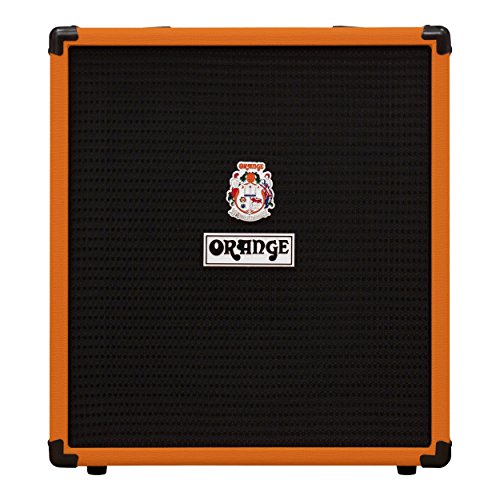
- 50 Watts of power output
- 12″ Speaker
- 22 x 14 x 21 inches dimensions
- Active 3 Band EQ
- Footswitchable gain and blend controls
- Built-in chromatic tuner
What We Think
The Crush 50 by Orange is a fantastic bass amp that nails down the tones you need for both classic and modern styles of playing. If you’ve been taking a look at the flagship Orange Crush models, you will be happy to find most of those aspects embedded in the Crush 50.
Reviews on the internet will tell you that the Orange Crush 50 is a good investment and even if you don’t think you will need the chromatic tuner built into the amp, it does come in quite handy. You can help your guitarist buddy out when he forgets a tuner at home which is something.
The ‘bi-amped’ style tones on this is something that will let you dial in the tone you absolutely love. You can go as mellow as you want or as harsh as you would like, and personally, I like to play around with the controls till I find something that I like.
This bass amp is something I would definitely recommend if you’re looking for a solid-state performance bass amp.
Specifications
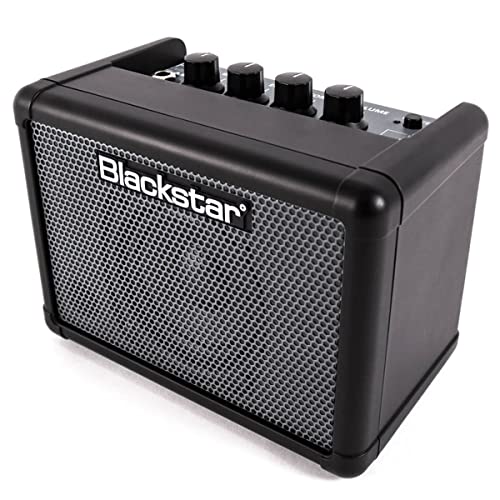
- 3 Watts 3″ speaker
- Features clean and overdrive channel;
- Infinite shape feature and built-in compressor
- MP3/Line In
- Silent headphone out
- Weighs 13.4 pounds
What We Think
So far, we’ve looked at amps with high watt ratings- even 50 Watts of power might be large for you, and if you just need an amp that costs cheap and will fit in nicely in tight spaces, the Blackstar Fly 3 will be just perfect for you.
Despite it being just 3 Watts, it’s quite loud for practice sessions. You get on-board compression, EQ, and a separate overdrive. I like the dual-channel feature a lot.
What I like most about this amp is that it runs on AA batteries, so you can also play it without any electricity as well. It also works as an external speaker which can come in pretty handy.
It’s well-priced at under $100 but I would suggest checking out the $120 stereo pack which offers a better value for the price.
Specifications
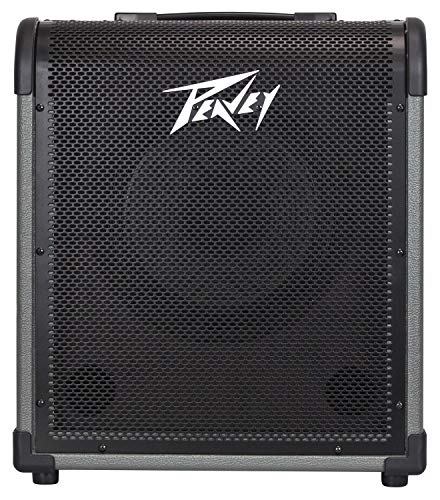
- Powerful 100 Watt speaker
- DDT speaker protection
- TransTube gain boost on pre-gain
- Full 3-band eq controls
- Overdrive, Contour, Mid-Shift, Bright, and Kosmos-C switches
- Weighs 29 Pounds
What We Think
Looking for a bass combo amp that’s pretty powerful but not super heavy? The Peavey MAX 100 Watt Bass Amp has got you covered with a Max 100 amp that can go all the way up to 100 Watts.
What I like about this is probably the fact that this amplifier has got both active and passive instrument input which can come in super handy if you got one of those. I do- and it saves me the trouble of having to get a separate bass amp for each of the bass guitars.
You also get a headphone jack which is great when you want to practice silently. So, the Peavey MAX 100 Watt Bass Amp is not only great for loud performances but also works great for quiet practice sessions in your bedroom. You also get AUX-in and a balanced XLR out which you will certainly need.
The 10-inch speaker packs plenty of power into the mix, and the fact that it’s got a built-in tuner is just great. Add effects like overdrive, contour, bright and Kosmos-C switches, and 3-band EQ, and you’ve got a beast of a bass amplifier that’s got you covered for anything really.
Specifications
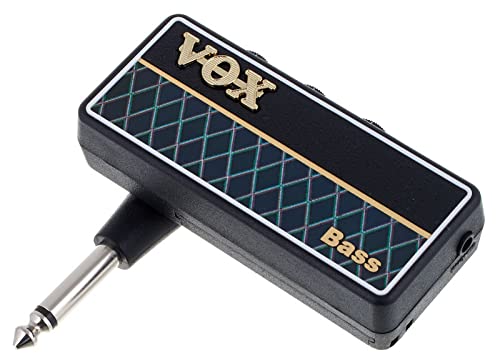
- Powered by 2 AAA batteries
- Aux in & Headphone out
- 3.39 x 3.15 x 1.22”
- 3 gain modes
- 9 selectable rhythm patterns
What We Think
For just $64.33, the Vox AmPlug 2 bass amp is a fantastic piece of electronics that will help you practice without making any noise thanks to the headphone output.
The circuitry on this is pretty high quality and you also get three gain modes and nine rhythm patterns which will come in very handy when you need to jam along with it. It also rotates 180 degrees for ease of use and automatically powers off after a certain time- certainly a great feature to save battery while the device is not in use.
The amplug 2 also has an AUX input that lets you use it as a portable mp3 player. And, it works with both bass and guitar- with a decent headphone, it sounds almost as good as bass through a real amplifier. Would definitely recommend for anybody who is keen on trying out a portable headphone amplifier that fits anywhere really.
How To Choose The Right Bass Amp For You
Tone controls:
If you’ve got a cheap bass amp, you will be limited to just the bass and treble controls which is fine for the bass guitar. But usually, even with budget bass amps, you can expect to get three basic controls- bass, mid, and treble controls, and occasionally, some amps even offer advanced features like equalizers that are based on different parameters. These do a fantastic job at splitting the amp output into specific frequency bands so you can access and modify these as you would like.
Some bass amps also offer clarity knobs that allow you to shape your tone even more intuitively. personally, I like having shape and contour circuits on my bass amp- as that comes in very handy when I am after a tone that I find resonates with my personal voice on the instrument. If you play around for a bit, you can also find pertinent sounds that fit blues or rock genres effortlessly.
Gain and resonance controls
I think gain and resonance controls have become ubiquitous these days, and the amount of gain you can dial in can help you reach that fantastic rock sound bands would kill to sound like. Being able to control the gain in the pre-amplification stage is great as it sounds a tad warmer which is great for the mix.

Every bassist is probably familiar with resonance and damping controls. Just play around with the resonance levels till you find a sound that you like- and you can get a crisp and tight tone from your amp that will work great with a band.
Channels on your amp
The first bass amp I got had dual channels- this meant that it was capable of producing clean or overdriven sounds, and I would stick to the clean channel most of the time.
Some amps take it a step further- and you get separate tone controls for the two channels that work independently. This may seem tricky at first, but in real-world settings, this can help you introduce new parts and creativity into your playing.
You would probably be good to go with dual-channel amps but if you have the budget, there are also some fantastic triple-channel amps on the market that allow you to use each speaker with a different channel. Of course, you would need to have three speakers to tr-amp them with separate channels but I’m sure that could come in handy if you’re into layering parts to form a harmonious whole.
Even if you just get a regular amp with speakers that aren’t of the same size, the amp circuitry will split the output into specific frequency bands and feed them to the individual speakers.
In-built tuner
Most bassists have built a reputation for being terrible bandmates – if you would like to stand ahead of the crowd, getting a chromatic tuner is a great way. If your bass amp has a built-in tuner that comes with you everywhere you take the amp, even better!
You also get a convenient display that lets you know the name of the note you are close to-and some even show by how many frequencies you’re off. Can come in very handy in the dark.
Impedance controls
This is a relatively new thing on amplifiers- basically, some bass amps allow you to switch between available impedance configurations for different sounds. The common ones are between 4 – 8 Ohms of impedance with a few offering impedances up to 16 Ohms.
Getting Rid Of Austerity With Footswitches
If you’ve got a guitarist friend, you may have seen him horde these small gadgets called pedals that he stomps on- and gets different sounds out of his guitar.
There are pedals and effects available for bass players as well. Check if your bass amp has got a footswitch jack- most do, and if yours doesn’t you will be missing out on the fun experience. it’s fine if you don’t think you need any effects but for most of us, footswitches provide a convenient way to get a different sound. So, get an amp that has got a footswitch jack- some amps even come with a footswitch!
Outputs
You don’t need to be astute to notice that the bass amp will most likely be hooked up to a mixer or a recording setup, and for that, most amps come with an XLR output. This is the case with most mics and if you’ve got an XLR out, you can easily connect to an interface like Focusrite.

There are numerous options for amp outputs- including the quarter-inch TRS output, XLR, and Neutrik connectors- and regardless of what you need to work with, having all of these will certainly come in handy someday.
You can also control the level of output and the non-cryptic labels will show you exactly what the knobs do for the output signal.
Inputs
The types of inputs have been augmented with time- and the most common types of inputs on audio devices are passive/active inputs and XLR balanced inputs. XLR inputs are probably less common on instruments and allow players to mic their instruments without hooking them up (with a microphone near the instrument).
The other kind- passive/active inputs work great with basses with passive/active pickups.
Other Accessories
Bass amps can also include several other accessories that might prove to be very useful for your needs.
The most common accessory you will find on most bass amps is a mute switch- which ensures that your bass amp is completely silent during tuning or switching between your instruments. If there’s a part in the song where you are supposed to not play anything and you want to follow along with your cool bassline, the mute switch can be a cool option to try out.
That way, you can play along with other players without disturbing anybody.
The display of your bass amplifier also matters a lot- is it a LED display, or a retro display that is hard to view? You should pay careful attention to whether it’s visible from all the angles as it can be an issue when you actually need to perform. It can also show the clipping levels on the audio output signals.
One of the things that I think is very important when it comes to tweaking the sound out of your bass amp is the effects loop- it allows effects to change the signals before it reaches the post amp section. It works with just a patch cord from your loop to the input of the effects. This can be a great addition to your toolbox- and is an easy way to change the sound of your bass.
Most bass amps consume heavy power- and for this reason, don’t feature the choice of batteries, but if the one you are wanting to get does, all the more power to you!
Wattage
Last but not the least, it’s important to check whether or not the amp wattage suits your needs. You could have gotten a sweet deal on a 90W bass amp but if your neighbors are naggy and won’t let you make a squeal, playing bass through the 90W bass amp is pretty much out of the question.
It’s important to only get what is needed- and if you’re just thinking about a bedroom practice amp, even a 3 Watts practice amp like Blackstar Bass Combo Amplifier will suffice.
I think a 50Watt amp would be great for most purposes- it’s plenty for outdoor gigs on small-medium venues, and if you get the amp with a silent headphone out, you can practice to your heart’s content without any noise complaints.
Final Thoughts
Summing up, whether or not you can play a bass through a guitar amplifier is not the issue here- you certainly can. But the thing is if you should stick to that idea.
Hooking up bass to a guitar amp will certainly produce some sounds, but you won’t get as rich a sound as you would if you had a decent bass amp. Getting a bass amplifier is obviously pricier and it would be great if you could get a combo amp that could do both. For the time being, I would recommend getting a separate amp for your bass and guitar as that will allow the specific frequencies to be heard best.
I hope this post has helped you get familiar with amps and you have learned something new.
Frequently Asked Questions
Can I play bass through a guitar amp?
Technically, the electronics on a guitar amp will let you play a bass through it but I would advise against that as you can damage the membranes on your amp and mess up the components. The output is also far from quality, so you’re better off sticking with a good bass amp. Having a dedicated bass amp also improves the quality for recording bass guitar to your computer or phone.
Is learning bass easier if I already know guitar?
Yep, I think most of the difficulty in learning bass is because of the larger fret distance. The style of playing is slightly different- you usually play just single notes and a couple of harmonies and stick to boring grooves.
The harder thing for most guitarists would be to resist the temptation to solo all around, and it does take some time to get adjusted to playing notes in the lower registers. Other than that, learning guitar first will give you a head start as you will be familiar with the fretboard. If you want to learn bass, you should directly learn bass as that’s the fastest way to learn and master the instrument.
Does hooking up bass guitar to a guitar amp mess up the electrical components?
In most cases, using a guitar amp with bass guitar won’t damage the internal components electrically. The amp simply tries to recreate the low frequencies and fails- so you get a sound poor in bass. You will just damage the physical components which can be avoided if you pay attention but it’s not really recommended for beginners. For those just starting, especially young players, choosing from the best bass guitars for kids can make a significant difference in their early musical journey.