
The bass guitar is a wonderful instrument- it’s just four strings (mostly), yet you can play almost anything on it.
If you are a bassist in a band, you will never need to think about upgrading to a more modern 5-string bass. In fact, most bassists go on with their careers without ever thinking about more strings on their instruments.
The transition from a 4-string bass to a 5-string bass is mostly pain-free, but there are some tips that will help you master the 5-string bass in no time at all.
This post will help you get started with a 5-string even if you’ve never laid your hands on a bass guitar before. Let’s get started, shall we?
Table of Contents
Transitioning From 4 String Bass To 5 String Bass
Treat the instruments as separate
I think the fastest way to learn the ins and outs of a 5 string bass is to treat it like an instrument. It’s very similar to leara ning ukulele if you already know guitar.
While you could get around just fine on the ukulele if you thought of it as a guitar with a capo on the fifth fret, you could get much further along if you thought of it as a distinct instrument and set aside some time to learn the shapes thoroughly.
Speaking of the differences, you can get a different range out of the 5-string bass guitar. The most common tuning on 5-string bass guitars is the E A D G C which means that you are tuning the fifth string to a C note. This tuning is good for pretty much all genres but if you need an extra low-end, you could go with the Low B E A DG which is also known as the low B tuning. Great for metal and more djent genres!

The TC Electronic PolyTune Clip is a fantastic tuner that will help you get the strings in tune.
Respecting a 5-string bass like a different instrument is not only a great way to learn it thoroughly, but it also helps you develop an appreciation for the instrument and progress much faster.
Get accustomed to the extra string
In terms of playability, there isn’t much difference when playing the 5-string as compared to the 4-string bass but the subtle change can throw you off when playing.
What you need to consider is the fact that the strings on a 5-string bass are much closer so you can unintentionally touch other strings when playing one.
To ensure that you’ve gotten used to the feel, you can try doing some scale exercises till you are sure that you’ve got the left-right coordination down.

If you are finding it hard to learn the 5 string bass guitar, you can also try playing the 5-string bass like a 4-string bass first, then you can try to figure out what the additional string is capable of.
By practicing on the 5-string the way you are comfortable first, you won’t be disappointed and will be motivated to keep learning new things on the instrument.
Playing on a 4-string bass is easier than on a 5-string bass because of the thumb position as well. You can try floating the thumb behind the fretboard and it will help you pivot your arm a bit easier. It’s also something most pro players try when playing on instruments with many strings.
Practice slow
As the old saying goes, a steady tortoise wins over the impatient rabbit- you can get amazing at bass if you keep at it rather than try to master everything at once.
It might be instinct for you to play the usual you would play when you would pick up your 4-string, but if you can break that habit and start a habit of being conscious about playing notes, you can improve a lot in a short period of time.
If you are a complete beginner, you may not know what the frets on a bass fretboard are, and this can hinder your progress. You will be stuck to the pentatonic shapes, and you likely won’t be able to transpose when you actually need to.
Play Scales with a metronome
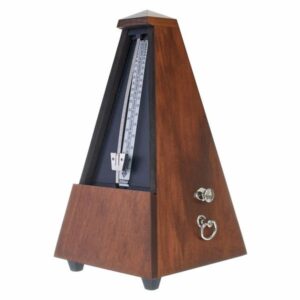
While learning the 5-string bass guitar with a metronome won’t make you amazingly good but it does help you keep a steady time if you practice diligently.
Most players tend to ignore learning their scales and modes, but if you are serious about learning the bass guitar, getting familiar with the major and minor scales is a good place to start. You will learn many things if you try learning the scales and arpeggios. It’s great for training your ear to hear the intervals.
You may have seen players playing songs without looking at tabs and improvising their way through the song. learning the scale shapes all across the fretboard will help you develop the confidence for that.
The C major scale is the notes C D E F G A and B and you can also try the major pentatonic which is C D E G and A notes. If you would like to learn about playing bass scales, you can check our guide to playing bass guitar scales.
Playing with a metronome at a slower pace can help drill in the time and subdivisions and once you get familiar with the tempo, you can work on increasing your speed till you are satisfied with it. You should be comfortable playing quarter notes, eighths, and sixteenth at a tempo of about 120 bpm to play along with most songs out there.
If you don’t know which one to choose, I would recommend getting the DB-30C Dr Beat Metronome by Boss as it offers a fantastic value for the price.
Learn to read music
Learning to read music can be intimidating at first, but if you invest some time into learning the staff notation and the basics of rhythm, you will be equipped with the means to get started transposing the piece for your own instrument.
Learning to play bass guitar is not only just playing the single notes but also thinking about the effect the notes you play can have on the feel of the entire composition.
Final Thoughts
Playing and mastering 5-string bass can be an exciting journey, and you might be interested in instruments with more strings. One thing that’s harder on the 5-string bass compared to one with just 4 strings is the bowing motions as the strings are a bit closer on the fretboard but with some practice, that should be a non-issue.
4-string bass is a good place to start for most bassists, and most don’t even care about having more strings on their instrument. You can, however, learn on a 5-string bass just as well, and if you get familiar with the sscale shapes and playing techniques, you can get more versatility out of the 5-string bass. This versatility makes 5-string basses suitable for many styles, and you might find them among the best bass guitars for funk.
I hope this post has helped you in some way. If you liked this article, please consider bookmarking our site, the shortcut is Ctrl + D.
Frequently Asked Questions
What are 5-string basses good for?
5-string basses are good for metal and other genres that need heavy sounds. The extra low B string on the 5-string bass can provide an aggressive heavy feel to an otherwise okay metal song which is awesome.
Is it OK to start with a 5-string bass?
While most players who have a 5-string bass opted to learn the 4-string bass first, you can absolutely learn on the 4-string bass. It just makes more sense to learn on the instrument you want to learn rather than start out on another instrument and transition to a 5-string later on.
Why do the strings rattle on my 5-string bass?
Strings rattling don’t have much to do with the fact that you’ve got a 5-string bass. It’s due to low action- action just means the distance between the strings and the frets, and if you have little space there, it will be easier to play but strings will rattle.