
The Roland Micro Cube amp is a compact micro amp on a tight budget.
The need for affordable headphone amps has become evident in recent years and there are a ton of options you can choose from. Sticking to a popular brand like Roland is a great idea if you want to be assured that the amp you’re getting is a well-reviewed one and a good value one.
The problem of finding a decent and portable guitar amp exists because electric guitars, unlike acoustic guitars need to be amplified to be heard. If you’re using a headphone amp, that can also be an advantage as it means that virtually no sound will be heard while you practice to play like the guitar greats you admire!
In this short review, we will take a look at the Micro cube portable amplifier by Roland to see how it compares to other mini guitar amp models in a similar price category. Let’s get started!
Table of Contents
Overview of Roland Micro Guitar Amplifier
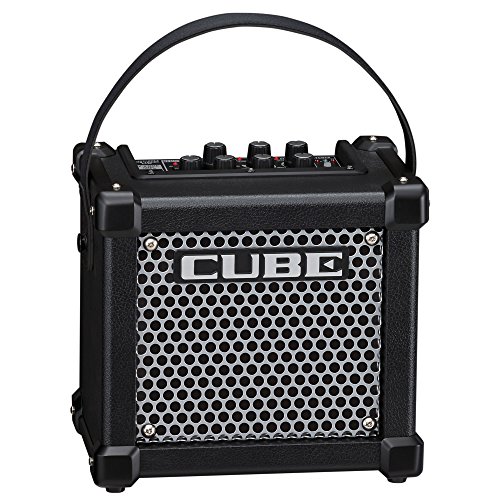
Specification
- 3-Watt amplifier
- Memory band
- 8 COSM amp tones
- Power adapter included
- Onboard effects
- 22.7 / 24.7 cm dimensions
Our Verdict
The Micro Cube amp is an excellent beginner’s amp that doesn’t cost much. However, it packs enough punch to be heard and runs on AC supply or batteries.
If you are very new to the world of electric guitars, this amp is a fantastic choice.
Roland
I don’t think there are many musicians that haven’t heard of or played on a Roland instrument. The brand is super popular with guitarists as well as keyboard players for the quality it provides on amps and effects.
The Roland Micro amp lives up to the brand name and is a fantastic purchase.
Features
The Micro Cube amp is a super portable guitar amplifier that weighs just 6 pounds with the dimensions of 22.7 * 24.7 cm.
It has a very basic 5″ closed-back cabinet setup with just 3 Watts of power output. As a result, the 3 Watt amp has a very low volume and will not help you at any stage but it’s adequate for good practice.
I really wouldn’t think of the Micro cube as a feature-rich amp but it shines as a quality practice amp which is what Roland has intended it to be used for.
It does come in three different shades- black, white and orange, so if you would like to opt for the bright one, you can easily do so.
The micro guitar amplifier has a dual mode of power and can be powered by a power adapter which comes with the packaging, or via AA batteries.
It runs up to 20 hours on battery power which is sweet!
Like other modeling amps, there are knob controls on the top panel which are really intuitive to use.
There is a quarter inch jack input for your guitar as well as an Aux cable so you can play from your device.
It also features an i-Cube link jack that connects to the i-Cube Link app on Apple devices. It’s handy for recording directly from the app but it doesn’t have an app on Android so that’s a bummer.
It also has a memory bank that allows you to store your settings and toggle that on or off. You can hold the memory button for a while and it will save whatever settings you are using.
The Micro cube amp is a modeling amp so it does have gain, volume and time which do as their names. What I don’t like about this amp is that if you turn the gain knob all the way to the right, it can sound a bit thin. This is a common problem on budget modeling amps so you will have to pick a sweet spot that works for you.
This amp also has a basic LED system that shows any digital effects selected.
What I like the most about this amp is that it has some cool features like chorus, flanger, phaser, tremolo and heavy octave.
The chorus effect comes in very handy when you need a rich sound for a specific part of your song, and the tremolo sounds quite good as well.
Inexpensive amps tend to do without a 3-band EQ, and the Micro cube amp doesn’t have a 3-band EQ control either. You will need to use the tone knob to play around with all frequencies, so that can be a problem.
Actually, the heavy octave has got you covered with a bass-rich tone so you only need to worry about the mids.
The Micro cube amp also has a basic chromatic tuner that shows when you are sharp or flat. It doesn’t tell when you’re in tune. It’s fine if you don’t need perfect intonation but I find a strap-on tuner to be of a higher accuracy and easier use.
The amp also has a Stereo output so you can plug in your headphones and listen to the amplified sound without bothering anybody.
There is also a strap on the amp that helps you carry the amp conveniently and the amp does come with an AC adapter.
Sound
The Roland Micro Cube amp may not be the best in terms of the tuners and EQ settings but it sure has some cool sounds- thanks to the 8 amp styles.
The styles run from clean tones to heavy and distorted, so you have lots of versatility when it comes to tonal possibilities.
The acoustic simulator channel on this does a good job at simulating the crisp warm sounds of an acoustic guitar. If you’re in a pinch, this will do just fine when practicing.
There is a JC style which offers a rich tone ideal for clean Jazzy voicings. There is also a Black channel that let’s you access a Fender Twin Reverb-like sound which is great for dirty blues and heavy rock. I find myself using the spring reverb and delay option very often.
The modeling amp is also capable of the Vox AC30 sound that was really popular in the 60s. This can also be used with a bit of gain to get a punchy tone.
If you want a classic Marshall tone on a budget, the Roland Micro Cube has got you covered as well! It let’s you sound like the Marshall 1987 Cabinet very conveniently.
There is also a rectifier channel on this that models a Mesa Boogie rectifier which is particularly great for metal and high-gain. If you’re into shreddy chops, the extreme amp style will fit you perfectly.
Overall, the amp tone is very nice for distorted tones as well as clean sounds. I wouldn’t use it for high gain though.
There is also a Mic amp style that lets you plug in your keyboards which is great!
Who it’s For
The micro cube amp is a good value compact modeling amp for beginners and intermediate level players. It’s quite lacking in terms of the features it provides but compared to other amps in the similar price category, it does fare well for a wide variety of genres.
It’s a bit expensive than the Blackstar Fly 3, so I would take a look into that before getting this amp. For players seeking another highly-rated portable practice amplifier, the Boss Katana Mini is also a strong contender in this category.
Score
Bottom Line
If you’re on the search for a portable modeling amp that can serve as a practice amp, the micro cube amp is a great choice. It has eight different amp styles, a memory bank, and also supports headphones which is great.
It’s an ideal amp for somebody who would like to practice quietly without letting the neighbours in on the noise. This amp is actually a good choice from a huge selection of amp models meant for beginner players.
FAQ
What batteries does the Roland Micro Cube amp use?
The Roland Micro Cube amp uses 6 AA size cells in the battery compartment and the battery life is quite good.